Sunday, January 18, 2015

What is KROSSE?

Our whole exchange is embedded in Krosse - a network of media content production at University of Bremen. But what is this "Krosse" we are talking about?

The german group of participants "Krosse" is a mixed group of bachelor students (communication and media sciences) and master students (media culture). We all have one thing in common: We all work for the project “Krosse”. 
 
The name “Krosse” refers to the german term “crossmedial”, which says that borders of media are being crossed. According to this, Krosse is not only an online magazine, but also a TV station and (starting in a few weeks) a radio station. Each has its own editorial which meets weekly, to talk about possible content and how to realise it. 
 
The online magazine is called “krosse.info”. As it is a very young magazine and also its members are young writers, it is not divided into “classic” departments like news, economy and sports. The magazine features articles about culture, media and leisure time in the local area (the north east of Germany). So you may read about music festivals in northern Germany, there are reviews of upcoming movies but also socio-critical articals and dossiers. Also check out their Facebookpage for further information!
 
Krosse.TV
The TV-Station linked to Krosse is called Krosse TV. You might view some of the shows on Youtube. Krosse TV is also produced on campus and follows the slogan: “jung.nah.bremen” (“young. close. bremen”). Every episode of Krosse TV tries to answer a certain question or  introduces something noteworthy happening at our University. That’s why in many parts of the show you may see different buildings of the Campus in the background. Furthermore there are surveys with students passing by. All parts of the show including generationg ideas and content, the shooting, the moderation and the cutting process are done by students. 
  
The third part of Krosse has just been launched. It is a radio station called “Krosse.FM”. Krosse.FM tries to establish a radio show made by students. Here, articles are written, music is chosen and moderations are being recorded. Similar to Krosse.TV there are also interviews with students or people working at our university. Once all the materials have been collected and recorded, the different parts of a show are being cut and put together. The show is then uploaded and may be streamed via krosse.info/krosse-fm/. Again, check Facebook for further information. 

Saturday, January 3, 2015

The German New Year's Eve

Happy New Year everyone! We hope you all had a great Christmas time as well as a memorable New Year's Eve ... But how do Germans actually celebrate this one night that separates 2014 from 2015? There are only little other events that are connected to such a variety of little traditions and customs like New Years Eve. For most of the people, it is a well-planned night that rises one's expectations to the maximum. And here are the top five traditions that make this night as special as it is:

1. Decorating. There are some items that represent luck in the new year. Most important is (lucky) clover that you can buy almost everywhere the weeks before New Year's, often decorated with little chimney sweapers in it. Little pigs represent luck and fortune during the next year as well. The decoration is placed on the tables, shelves, maybe outside ... Confetti and paper streamers complete the decoration.

2. Eating. Families and groups of friends have different traditions when it comes to food. Well-known is herring salad or egg salad and so-called "Berliner": ball-shaped fried dough with jam in it. There are other sweet bakery products made of the same dough that are very popular. People also love doing fondue - sticking little pieces of meat in broth or fat - or raclette. With raclette, you put different already cut food on tiny pans and eat them up on a raclette grill. Both are very social and can feed a large group of people.

3. Games. Only for New Year's Eve, people do "Bleigießen" (casting lead). Here, you heat up a small piece of metal (it used to be lead) on a little spoon over a candle. Once it is liquid, you quickly drop it into cold water. After this, you examine the little figures that were created because the metal got cold so quickly. Sometimes, you can see different figures like animals or things and can interpret how they might be connected to your upcoming year. There are also little books for explanations which symbols stands for what. Thinking of own interpretations is the most fun anyway though.

4. Countdown and fireworks. Close to twelve, bottles of sparkling wine or even champagne are opened. Then, there is normally a countdown and at twelve, everyone is hugging each other saying "Frohes Neues" which means Happy New Year. Some Germans love to have their own firework and light it up in the streets. There are strict restrictions though: You can only buy fireworks right before christmas and they can only contain small amounts of some chemical ingredients. Safety first!

5. Watching TV. There is one show that is very popular and is only watched once a year: on the 31th of December. It is called "Diner for one" and is a british short movie where a rich old lady and butler have dinner together. Since all of the lady's friends already died, the butler has to drink each and every drink they would have drank if they would still live. Obviously, the butler gets massively drunk and repeatedly stumbles over a certain fur that is lying on the ground. People know this movie by head yet still laughing about every scene.

I hope you got an impression of New Year's Eve in Germany - of course, there are tons of parties everywhere ... the most known might be the one in Berlin in front of the "Brandenburger Tor" but a lot of clubs, bars, restaurants and private people host parties all over Germany.

Tuesday, December 9, 2014

Clear the stage for ...

The writing, filming, discussing, editing, reviewing and improving of the movies is done. Today, the German movies are presented in Chișinău. Christoph Sodemann, initiator of the project, is in Moldova right now to work with the students and present the movies from Bremen. This day is so special because on the one hand, it is the first milestone in terms of bringing the two working groups together, on the other hand, authorities from the German embassy are there to gain impressions about the project.

But now - clear the stage for the German movies:

1. 360° Bremen - The City from our Point of View. A short documentary about Bremen not how it would be presented in a sightseeing tour but the personal Bremen of three students. Here, you can experience parts of Bremen from a personal perspective, including the first art house cinema and the famous christmas market.

2. Uni Bremen News meets Gesa. The short film is based on an interview with a media and communication student at the University of Bremen. Vased upon that, the audience gains impressions about a student's life, the university and the major "media and communication". The whole movie is interesting as well as funny.

3. Students Everyday life in Bremen. The third movie is strong in it's images: three girls present their very own and completely different daily life as a student. While following Felisa, Clara and Denise through a typical day of waking up, university, jobs and freetime activities, you also get information about the costs of the life as a student in Bremen.

Enjoy!

Monday, December 8, 2014

Alexandru Cantir: “There is no good journalist in only one media area”

Alexandru Cantir
In the fourth week of the TV journalism project, 
students had the chance to meet with some of the best journalists in Moldova. One of them is Alexandru Cantir, one of the most famous professional journalists from Moldova, who has a career in the field for several decades. During the meeting, participants learned the success story of the journalist, found details about the crisis and the collaboration project during his career.

Alexandru Cantir made his debut in journalism during the Soviet period. Curiosity attracted him to quality journalism and not propaganda-type of journalism, packed in boxes as it was at that time. He began working as a reporter since the second year of faculty.
One of the most important periods of his career, as he said, was in 1992 when he became a war correspondent and an officer, in same time, in the armed conflict on the Dniester. It was a short period, but this made him stronger and more attentive to the things that are happening around and about the decisions that a journalist had to take in his career.
After a brief period, with his colleague Vasile Botnaru, he founded the first independent news agency in Moldova, BASA-PRESS Agency, which presented a new approach of journalism to social reality, also being a phenomenon on Moldavian media market. In the same period, he began a fruitful collaboration with the BBC team in Romania which lasted until 2006, classifying it as the best time of his career. In present, Alexandru Cantir is editor-in-chief of the news agency IMEDIA and also he is moderator of the morning show "Moldova on 7" on Radio Free Europe in Chisinau.

Talking with future journalists about the current situation of the media in Moldova, Alexandru Cantir noted: „Unfortunately, now I have more disappointments about how journalism works in our country. Until a few years ago, there was a kind of care and dedication to the profession, nowadays the importance of journalism profession begun to trivialize. It trivializes because it was turned into a business, because when the foundation of each media channel is placed strictly according commercial or political interests, then things start to go crazy. Those journalists and editors no longer complies with the rules of ethics.”
In all these years of journalism, he has created a personal and professional ethics, namely: truth above all, no matter what effect it has. „I had no bosses to dictate me other than law of profession, even if I had conflicts with some newsrooms where I worked,” said Cantir.

Asked by students which are the problems that young journalists have when they go to engage, Alexandru Cantir said that „few of them know how to impress the editor. Also few of them know the language perfectly and this is a big problem, because if you don’t know the language you have no idea how to send the message to the public. Another problem is the readiness for a job like this, because to be a journalist requires a special passion and a good grounding to feel comfortable psychologically. Otherwise, you might feel tempted to quit and get retrained.”
At the end of the meeting, the journalist gave an advice to all those who wish to enter the field of journalism. He said that a good journalist must be good in all spheres: in newspapers, and radio and TV, there is no good journalist in only one area. And over the years it was shown that to become a good journalist it needs a lot of work and sometimes even sacrifices.

by Cristina Curcan


Sunday, December 7, 2014

Short films are coming up!

Hello everyone!
Taking notes to improve the movie

Our students in Chișinău and Bremen have been working hard on short movies to present their culture, cities, and daily life throughout the last weeks. And finally, we will be able to see results! On Friday, the German group of bachelor and master students gathered with their lecturers to present their temporary results. After receiving useful feedback from the group, there was some more time to improve the movies even further. We can be excited about movies that are as different as the members of the group themselves: there will be a personal Bremen documentary, an insightful as well as funny interview with a media and communication student and the presentation of a student's daily life with strong images and fun facts. On Tuesday, the 9th of December, the movies will be uploaded for everyone to enjoy. Until then, stay tuned for more information about the project. 

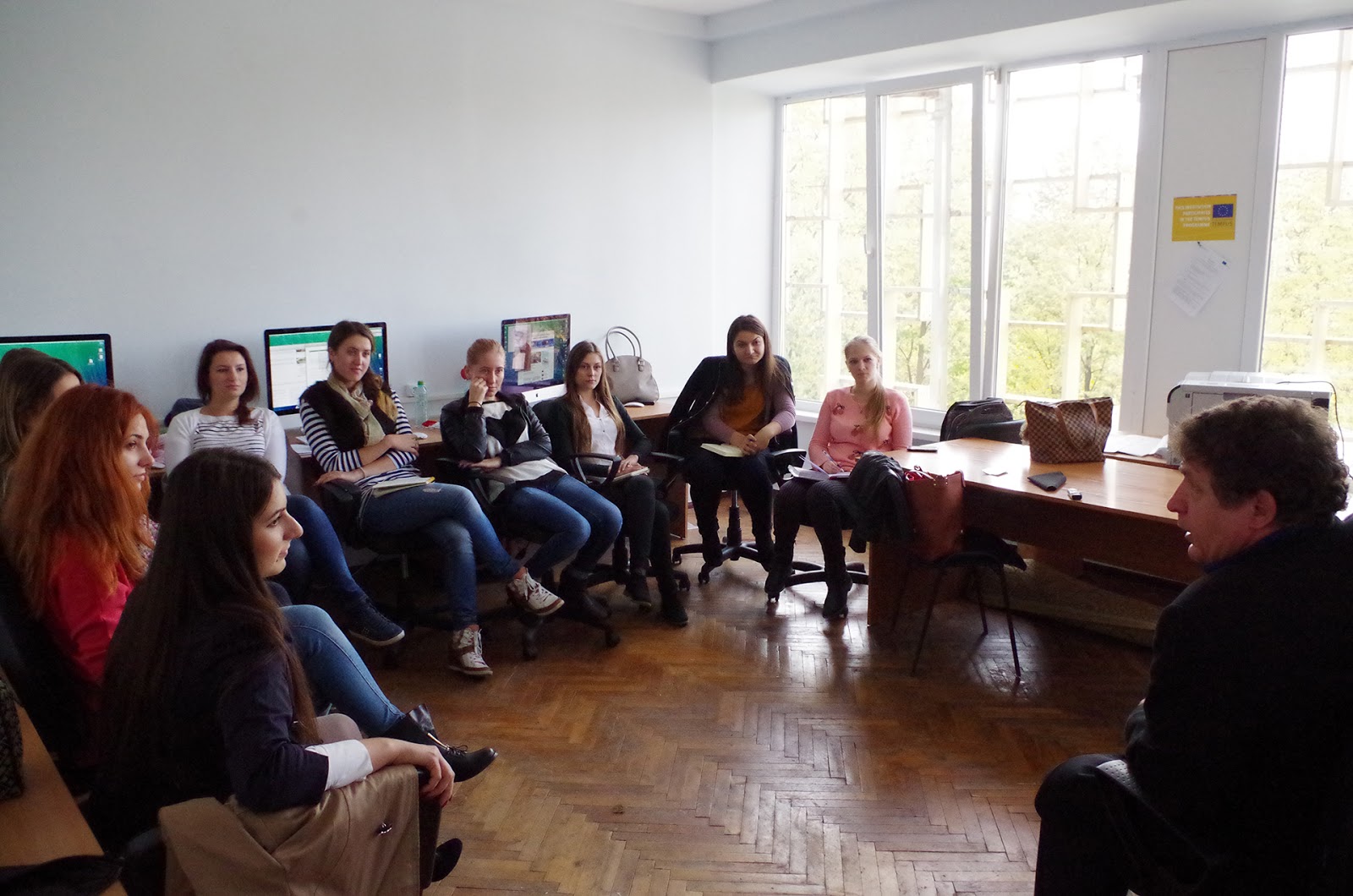
The lecturers discuss the movies with the students
Beneficial feedback from and for the German students